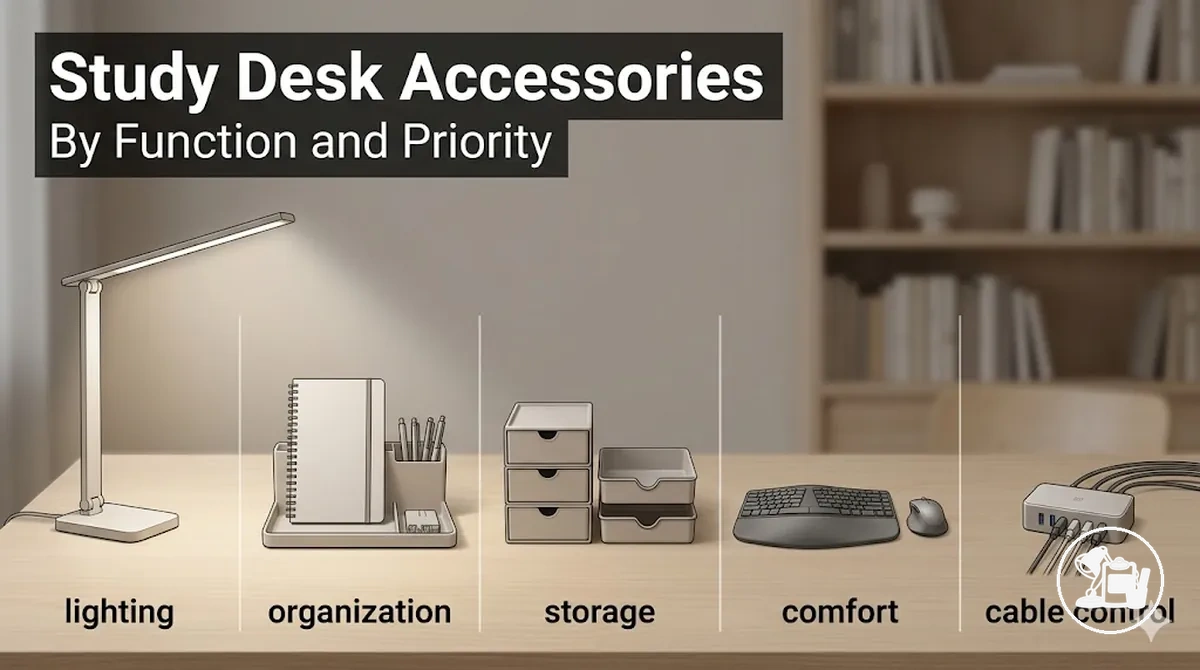
Essential Study Desk Accessories by Function and Priority
Essential study desk accessories are functional items designed to support a study desk setup by enhancing organization, accessibility, and usability. They act as decision-support tools, helping users maintain a clear desk surface while providing structured storage, effective lighting, and controlled cable management. These accessories create a workspace suited for focused reading, writing, and task performance, with their main usefulness framed around functional desk efficiency and order.
The key functional categories include organization tools for daily supplies, lighting solutions for reading and screen comfort, storage for books and papers, cable control for devices, and surface support items like mats or risers. Each category addresses specific study needs, connecting to selection priorities based on daily tasks and desk requirements. Organization maintains access and reduces clutter, lighting enhances visibility and eye comfort, storage manages bulkier items without crowding the desk, cable control keeps wires orderly, and surface support optimizes workspace comfort and usability.
Determining priority among these accessories depends on the desk condition, individual study style, and frequency of use. Users may emphasize certain categories over others depending on functional gaps, such as limited space, multiple devices, or paper-heavy activities. Understanding these priorities prepares readers to explore each accessory type in more detail, allowing informed selection for a study desk setup suited to their specific needs.
Understanding Essential Study Desk Accessories
Essential study desk accessories are items that serve functional roles in a study desk setup, connecting each accessory to a specific function or type and the conditions in which it provides benefit. For guidance on what study desk accessories include, these tools typically enhance desk organization, lighting, storage, or cable management, rather than acting as purely decorative pieces. For example, a desk lamp can improve visibility during study sessions, while an organizer tray ensures supplies remain accessible and orderly.
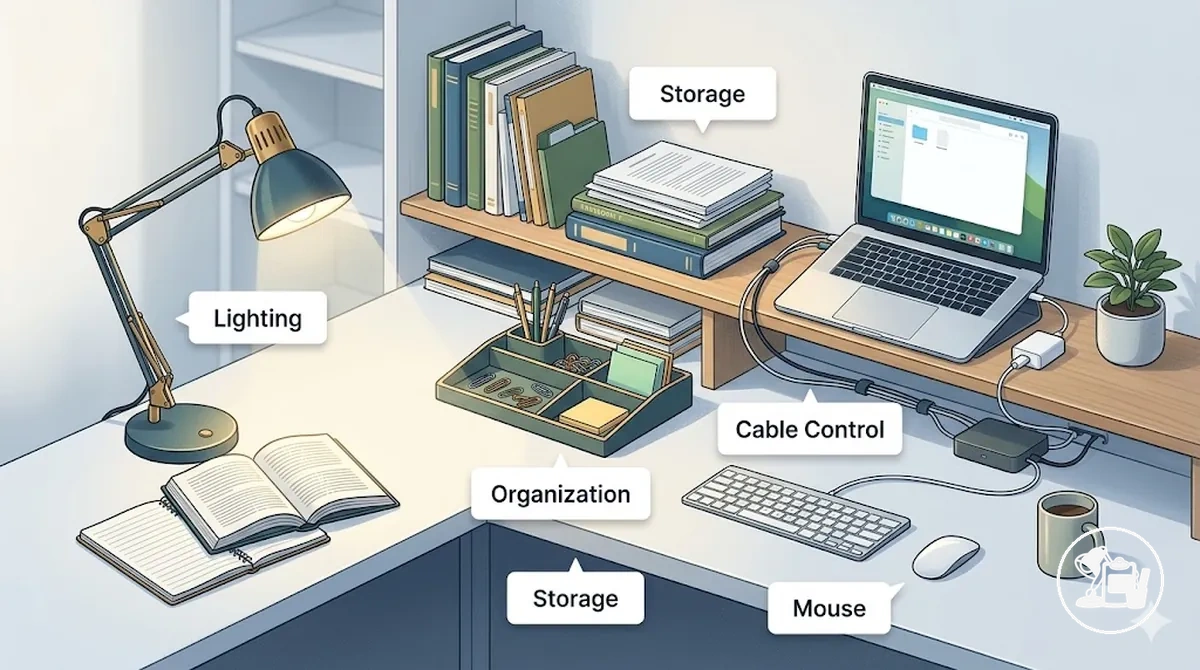
These accessories generally fall into categories such as lighting for reading and writing, organization for frequently used supplies, storage for books and papers, and cable control for managing devices. Their function is to support daily study tasks by maintaining an orderly workspace, facilitating access to necessary materials, and reducing visual clutter. The effectiveness of each accessory varies depending on the desk layout, study habits, and routine use, providing a structured foundation for core study desk functions.
Core Functions and Key Attributes
Core functions of essential study desk accessories include lighting, organization, storage, cable management, and surface support, which define their role in maintaining a functional and organized study workspace. Recognizing these key attributes helps in selecting accessories that fit the desk layout and support daily study needs effectively.
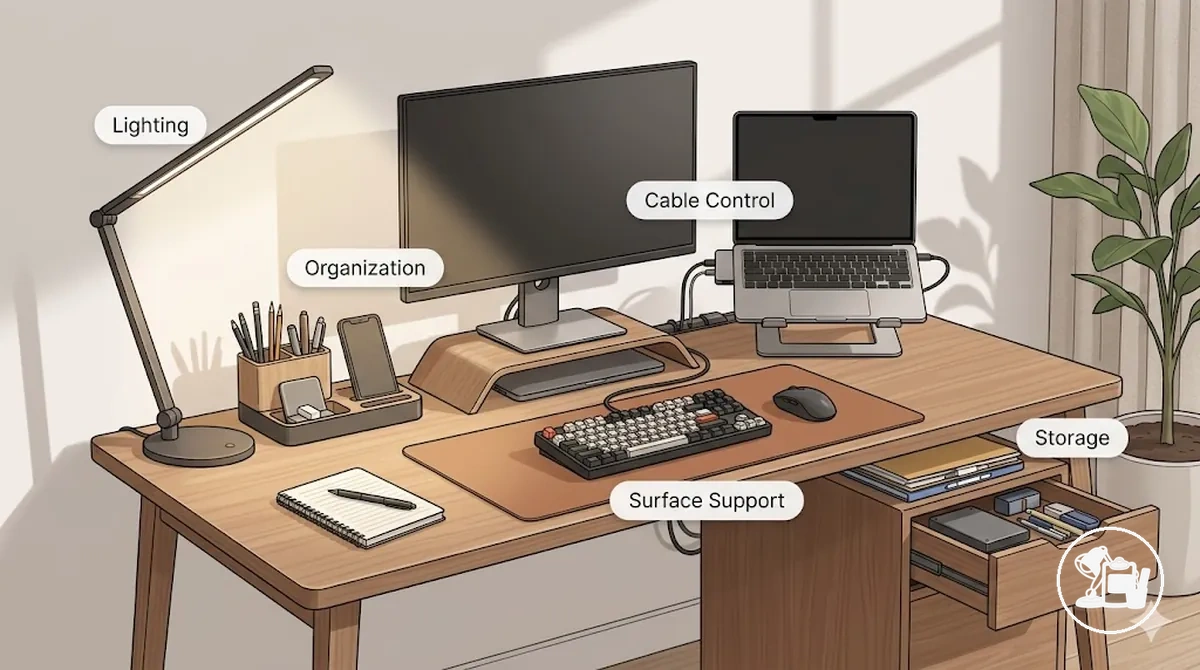
Each core function links to specific attributes that influence their effectiveness in context. Lighting depends on brightness and adjustability to support reading or writing tasks. Organization relies on compartments and accessibility to keep supplies within reach. Storage emphasizes capacity and fit for books or papers. Cable management ensures wire control and safety for devices, and surface support provides comfort and desk stability. Consider these attributes carefully relative to desk use and study routines to optimize workspace utility and avoid unnecessary clutter.
The core functions and key attributes depend on what the study desk needs to support:
- Lighting → Brightness & adjustability → Enhances task visibility
- Organization → Compartments & accessibility → Keeps supplies within reach
- Storage → Capacity & fit → Maintains order for books and papers
- Cable management → Wire control & safety → Reduces clutter and tangling
- Surface support → Comfort & stability → Supports desk usability
Lighting: Comfort and Productivity
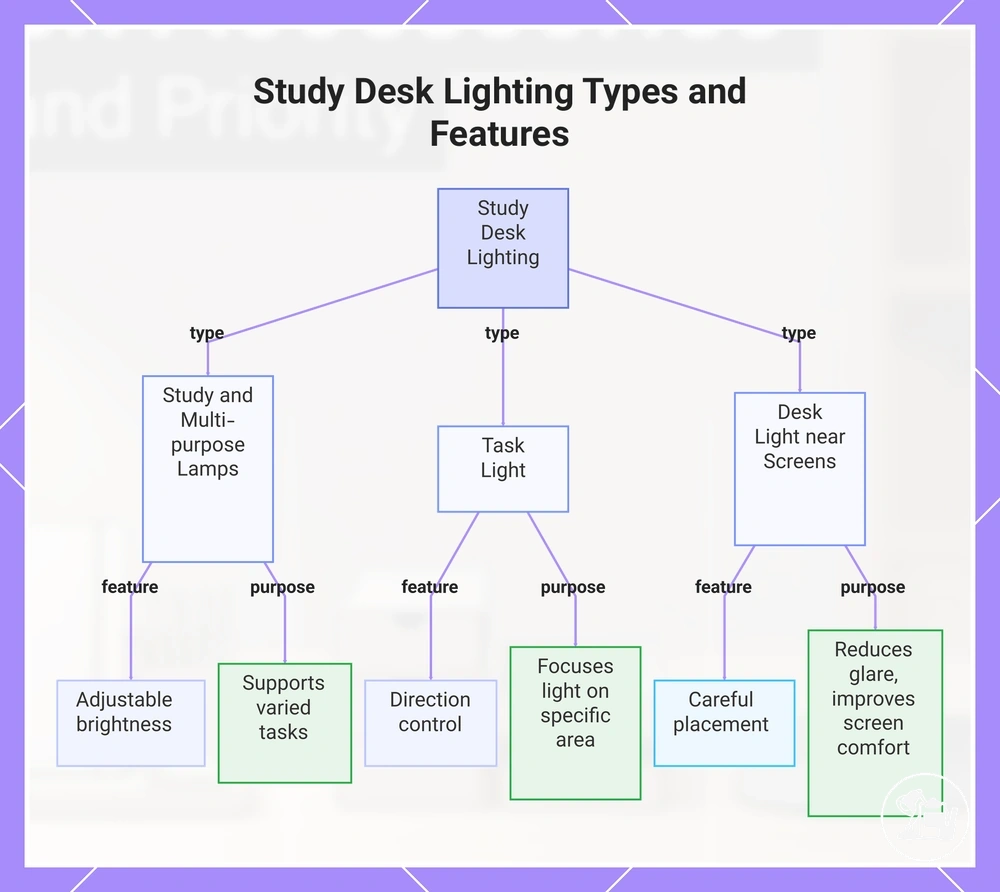
Lighting for a study desk is determined by brightness, direction, and adjustability, as these factors affect reading, writing, and screen comfort. Proper illumination can enhance task visibility and reduce glare, while the placement of the light influences overall eye comfort under different ambient conditions.
Lighting solutions can be organized by type, brightness, and study use:
- Study lamp → Adjustable brightness → Supports reading and writing tasks
- Task light → Direction control → Focuses light on a specific area
- Desk light near screens → Careful placement → Reduces direct glare and improves screen comfort
- Multi-purpose lighting → Brightness adjustability → Adapts to varied study activities and desk setups
Optimal comfort and focus depend on lamp placement, ambient light, and alignment with screen positions.
This chart shows the main types of study desk lighting, their key features, and how they support comfort and productivity.
Organization: Daily Supplies and Desk Order
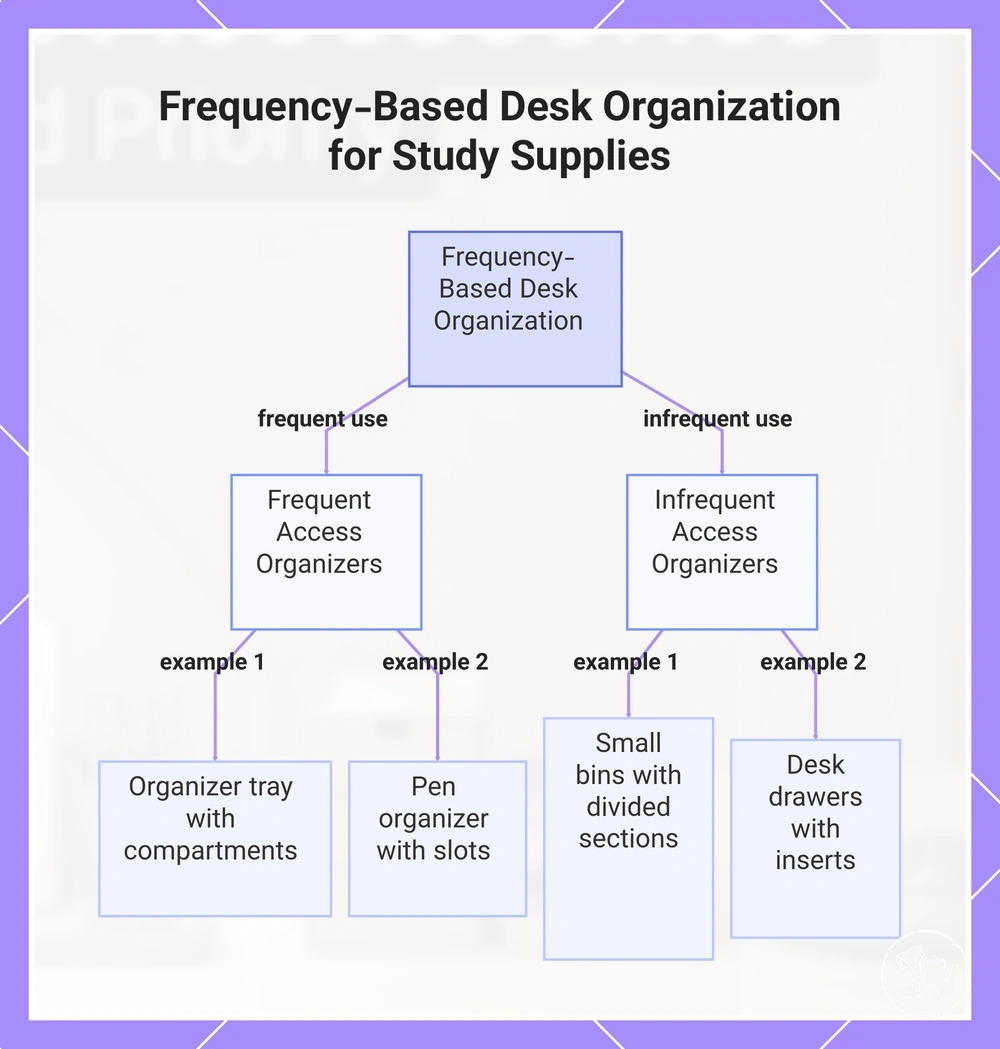
Effective organization of daily study supplies depends on their frequency of use and the need for easy access to maintain desk order. Using structured organizer trays, pen holders, and compartments helps ensure that frequently used items are accessible while preventing clutter from accumulating.
Organization can be tailored based on supply type and access needs:
- Organizer tray → Multiple compartments → Keeps pens, pencils, and small stationery within easy reach
- Pen organizer → Vertical or slotted design → Separates writing instruments for quicker access
- Small bins or boxes → Divided sections → Stores miscellaneous items like paper clips or sticky notes
- Desk drawers with inserts → Structured layout → Provides order for less frequently used supplies
Maintaining desk order depends on the organizer structure and how supplies are grouped. For additional options, see organization accessories.
This chart shows how to organize daily study supplies into frequent and infrequent access categories using specific organizer types.
Storage: Books, Papers, and Extras
Storage helps keep books, papers, and extras accessible without overcrowding the workspace. A suitable storage setup separates bulkier or less-used items from daily supplies, making the desk easier to use while maintaining accessibility. Storage capacity and placement influence how efficiently materials can be reached when needed.
Storage choices depend on item size, access frequency, and available desk space. For more selection criteria, see storage accessories.
- Desktop storage shelf → Visible capacity for books and papers → Keeps reference materials within reach while preserving workspace
- Under desk storage drawer → Hidden storage location → Improves accessibility for documents without using desk surface area
- Storage box → Contained capacity for extras → Groups miscellaneous items and reduces surface clutter
- Vertical storage rack → Upright arrangement for notebooks and papers → Uses available height when desk space is limited
The most suitable storage solution depends on the size of stored items, available capacity, and how frequently books, papers, or extras need to be accessed.
Cable Management for Devices
Cable management organizes chargers and device wires to prevent desk clutter and improve safety. Proper cable control ensures wires are routed neatly, maintaining desk order and minimizing risks associated with loose cords.
Effective cable organization depends on device count, cable length, and charging positions:
- Cable clips → Flexible hold for multiple wires → Keeps chargers and device cables tidy
- Cable sleeves → Bundled capacity → Groups wires to reduce tangling and visual clutter
- Cable tray → Desk-top or under-desk placement → Routes longer cables efficiently without obstructing workspace
- Cable box → Enclosed storage → Hides adapters and excess cords while maintaining desk order
Desk order and safety improve when cable organization is aligned with device use and cable routing. For more options, see cable control accessories:contentReference[oaicite:0]{index=0}.
Surface and Support Accessories
Surface and support accessories are items designed to enhance desk use by improving contact, adjusting height, or creating more usable workspace. A desk mat can provide a cushioned surface, while a laptop stand or riser can adjust viewing height and free space. Their impact on comfort and workspace depends on desk layout, device size, and user setup:contentReference[oaicite:0]{index=0}.
These accessories change how the desk surface functions and support different study setups:
- Desk mat → Cushioned surface → May improve comfort and define workspace boundaries
- Laptop stand → Height and angle adjustment → Can optimize viewing angle and free space beneath the device
- Riser → Elevated support → Adds usable space and adjusts device height when fit allows
Choosing the right surface support depends on available desk space, required height adjustment, and workspace needs.
Accessory Prioritization by Study Desk Needs
Accessory prioritization depends on the study desk’s biggest functional gap. A desk with limited visibility may need lighting before other additions, while a desk affected by clutter may benefit from organization or storage tools first. Matching study desk needs to the most immediate limitation creates a practical selection framework and a clearer decision process.
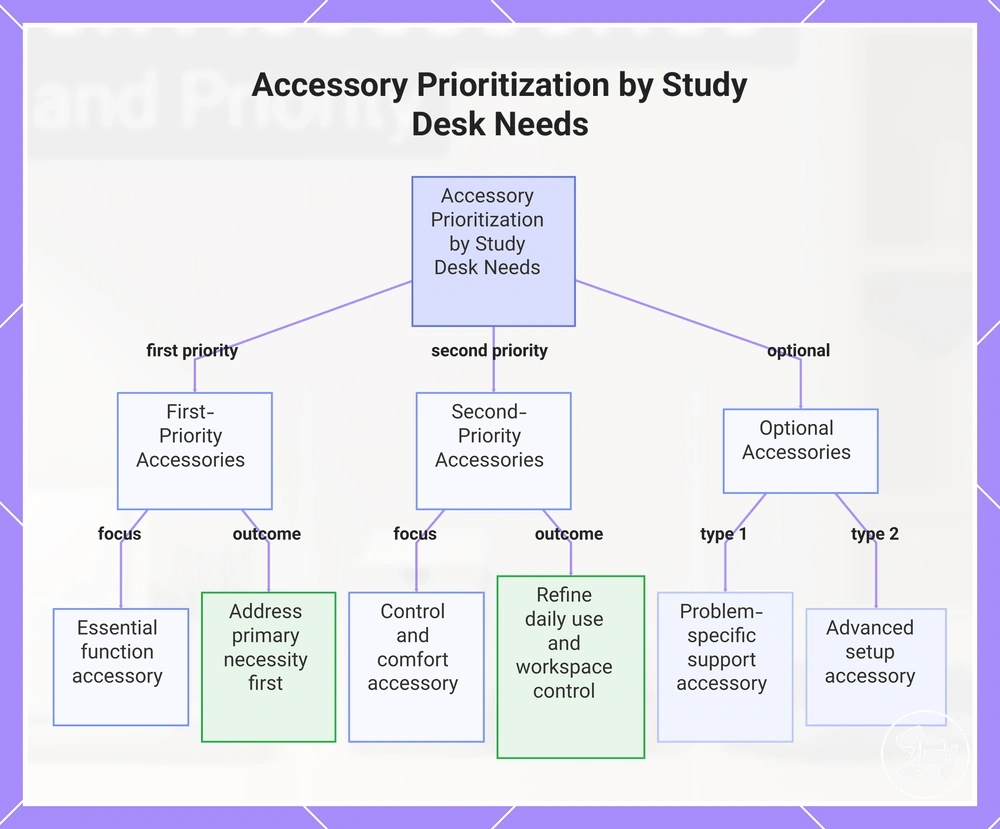
Accessory prioritization usually follows a progression from basic function to improved control and then to optional problem-solving support. First-priority accessories address necessities that affect daily study tasks. Second-priority accessories focus on comfort, accessibility, or efficiency after core functions are covered. Optional accessories are typically chosen when a specific condition remains unresolved or when an advanced setup requires additional support.
Accessory prioritization by study desk needs is easier when each priority is matched to a functional gap:
- First-priority → Essential function accessory → Daily study is affected by limited visibility, organization, or workspace usability → Decision outcome: address the primary necessity first
- Second-priority → Control and comfort accessory → Core study functions are available but efficiency or access can improve → Decision outcome: refine daily use and workspace control
- Optional accessories → Problem-specific support accessory → A condition such as cable routing or surface support remains unresolved → Decision outcome: target a specific workspace need
- Optional accessories → Advanced setup accessory → Study desk needs extend beyond essential requirements → Decision outcome: add support based on fit, usage patterns, and workspace goals
For a broader comparison of priority order and accessory choice, review the accessory checklist before making a final selection.
This chart shows the three priority levels for selecting desk accessories based on functional gaps, from essential necessities to optional advanced support.
First-Priority Accessories for Basic Function
First-priority accessories are essential items that support the core function of a study desk. They address immediate needs that influence daily study activities, such as visibility, access to supplies, and organized cable management. Selection depends on which fundamental function is currently limited, creating a clear basis for accessory choice.
These accessories should support basic study desk use before adding optional or convenience items:
- Lighting → Provides illumination for reading and writing → Ensures tasks can be performed efficiently when desk lighting is insufficient
- Organizer → Maintains access to daily supplies and reduces clutter → Keeps frequently used items within reach for smoother workflow
- Cable control → Manages device cords and chargers → Helps maintain desk order and reduces distractions from loose wires
- Basic desk item → Fills a functional gap → Supports essential daily study activities depending on current desk needs
Each first-priority accessory is selected based on its contribution to basic desk functionality and how it addresses a critical limitation in the study environment:contentReference[oaicite:0]{index=0}.
Second-Priority Accessories for Enhanced Control
Second-priority accessories are selected after basic function is in place and are intended to improve enhanced control, comfort, or efficiency during study desk use. These accessories refine how the workspace is used without replacing essential items such as lighting or basic organization. Their purpose is to add adjustment, support, or improved access to tools that help manage daily study tasks more smoothly.
Second-priority accessories typically enhance control and comfort after basic function is supported:
- Laptop stand → Height adjustment and device support → Can improve viewing position and workspace control when screen placement is limited
- Desk mat → Surface comfort and work-area definition → May enhance desk control and comfort during extended use
- Organizer upgrade → Additional compartments and structured access → Can improve efficiency when basic storage is insufficient for daily supplies
- Support accessory → Adjustment or positioning features → Can provide additional workspace control or comfort depending on study desk needs
Selection of second-priority accessories should consider which aspects of control, comfort, or efficiency are most relevant once essential functions are already addressed:contentReference[oaicite:0]{index=0}.
Optional Accessories for Specific Desk Challenges
When a specific desk challenge exists, optional accessories can make sense as targeted additions rather than essential items. These accessories are typically used in an advanced setup where a particular condition affects workflow, organization, or available space. Selection should depend on the problem being addressed and whether the accessory provides a suitable fit for that situation.
Here are product examples that may make comparison easier. Before buying, always review the compatibility criteria, essential features, and product details.
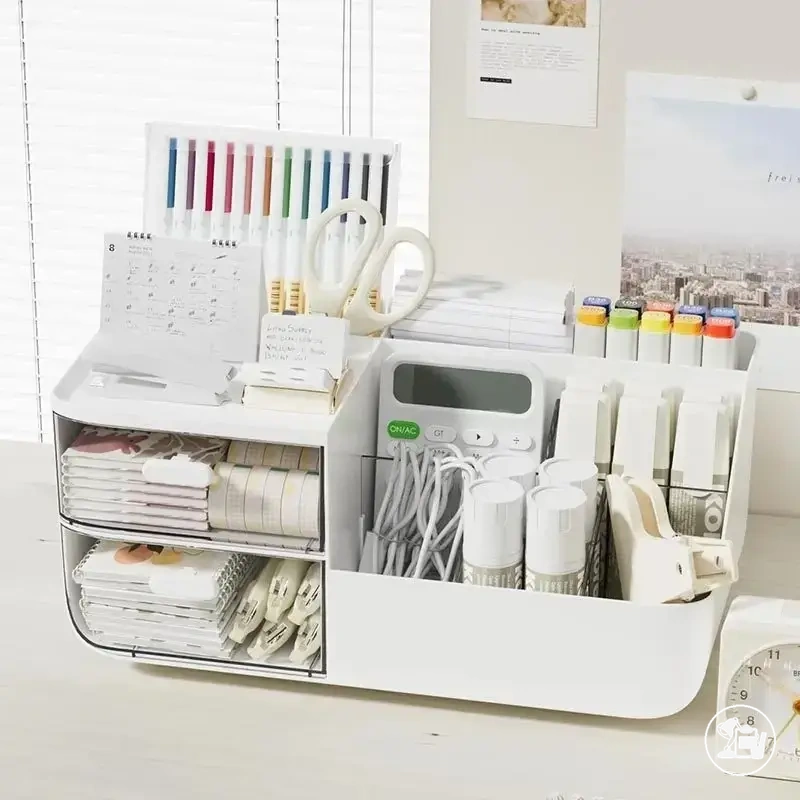
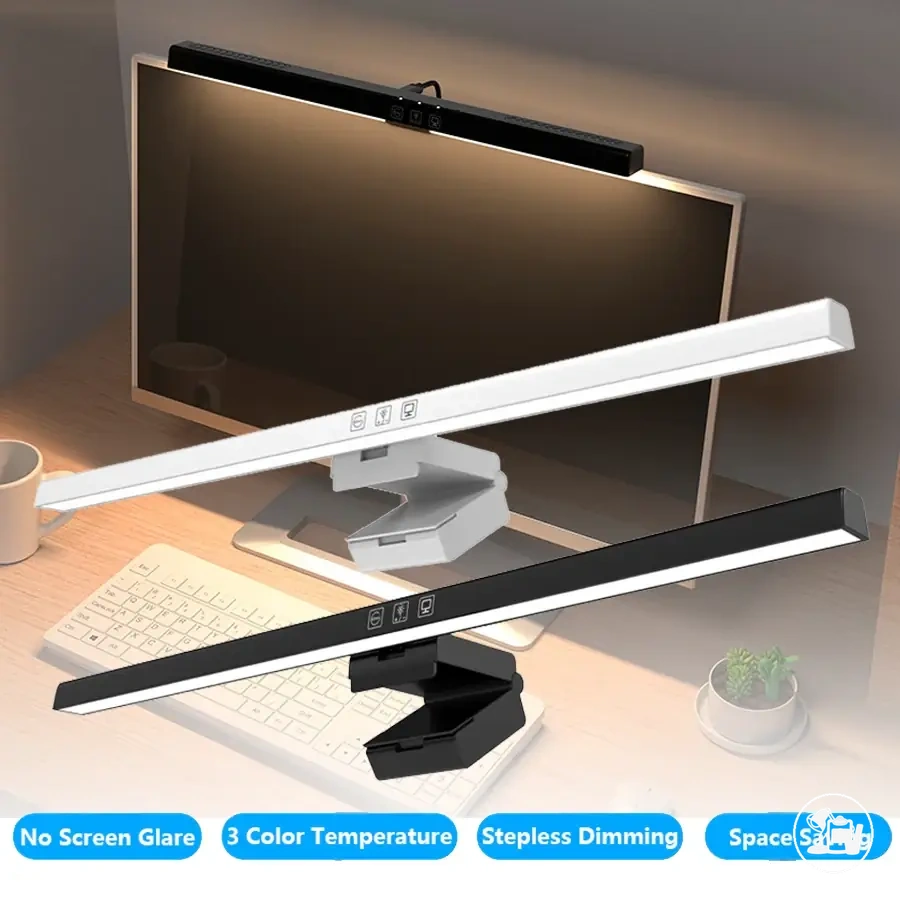

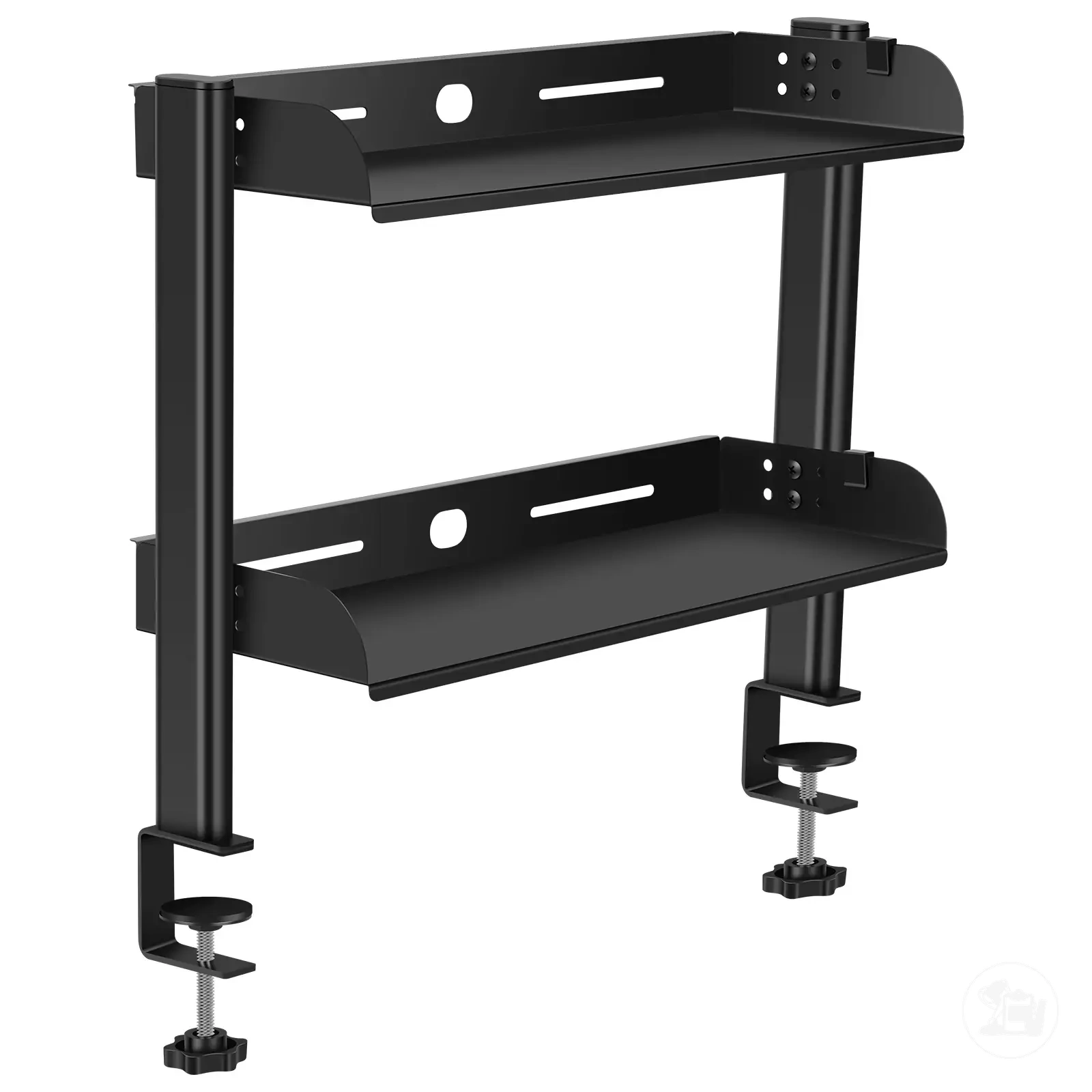
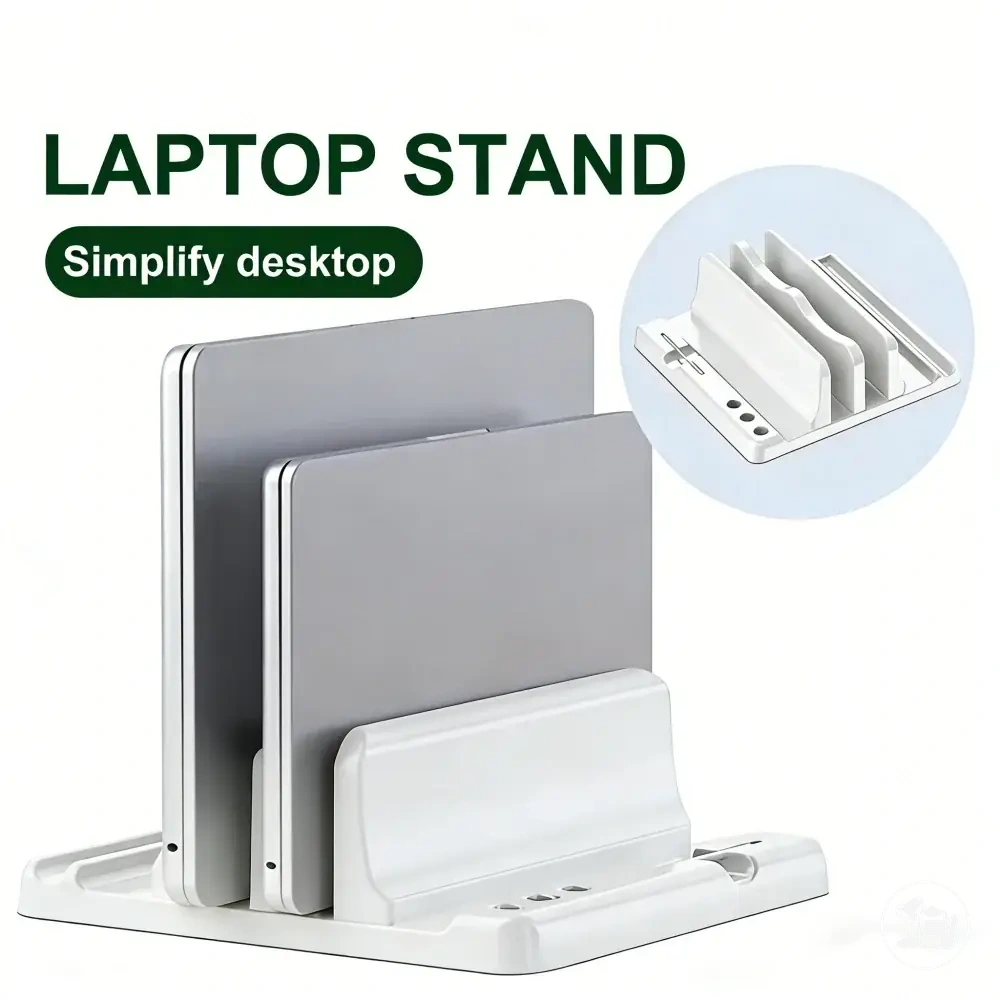
Optional accessories should be matched to specific desk challenges rather than added by default:
- Limited surface area → Compact accessory → Space-saving design → May create additional usable workspace when desk space is restricted
- Many devices → Cable control or charging accessory → Multi-device organization → Can improve cable management and device access when connections become difficult to manage
- Paper-heavy setup → Storage or sorting accessory → Organized access and categorization → May improve document handling when papers accumulate frequently
- Comfort-related condition → Problem-specific support accessory → Adjustment or positioning feature → Can improve workspace fit when a particular comfort issue is present
Optional accessories remain condition-based choices, and their effect depends on how closely the accessory matches the specific desk challenge being addressed.
Matching Accessories to Desk Conditions
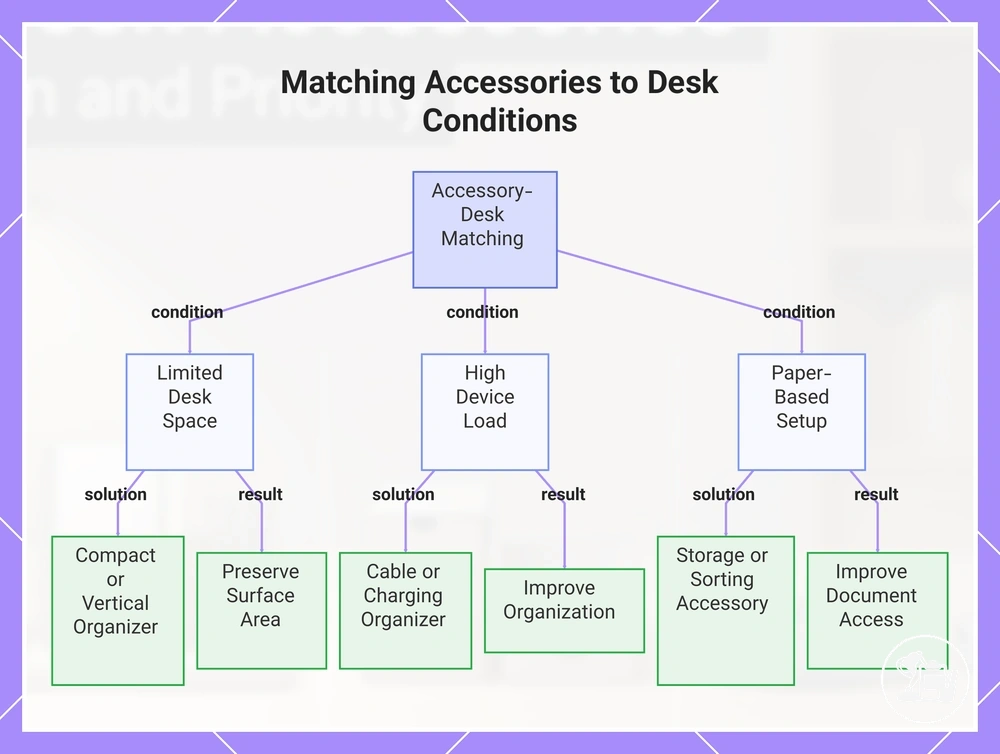
Accessory fit depends on desk conditions such as desk space, device load, and study material type. A compact study environment may require different accessory choices than a device-focused or paper-based setup. Compatibility is strongest when the accessory choice matches what the desk must hold, organize, or support under current conditions.
Matching accessories to desk conditions can help reduce unnecessary purchases and workspace clutter. Desk space influences whether a compact or space-efficient accessory provides a better fit. Device load affects the need for cable control and organization, while a paper-based setup often benefits from solutions that improve storage, access, and sorting. The outcome depends on selecting accessories that align with the primary desk condition rather than adding items without a clear purpose.
Matching accessories to desk conditions requires checking what the desk must hold and support:
- Limited desk space → Compact accessory or vertical organizer → Decision: preserve surface area while maintaining access to essential items
- Higher device load → Cable control or charging organization accessory → Decision: improve organization when chargers and cables occupy workspace
- Paper-based setup → Storage or sorting accessory → Decision: improve access to documents when paper volume increases
- Mixed study environment → Flexible organizer or support accessory → Decision: choose the accessory that best matches the dominant desk condition and expected outcome
Compatibility depends on desk size, device requirements, material volume, and daily study use, so accessory choices should be evaluated against actual desk conditions before selection.
This chart shows how three primary desk conditions determine the most suitable accessory type and its intended outcome.
Optimizing Accessories for Limited Desk Space
Limited desk space requires accessories that are compact, vertical, or multi-use to maximize surface area while maintaining functionality. Space optimization depends on selecting items that fit the available footprint and provide accessible storage or support. Accessory choice should prioritize efficiency and surface clearance for daily study tasks.
Optimizing accessories for limited desk space involves considering footprint, height, and access:
- Compact organizer → Multiple compartments → Reduces clutter and keeps essential items reachable while saving surface area
- Vertical storage → Tall shelves or stacking units → Increases storage capacity without expanding desk footprint
- Small desk lamp → Adjustable placement → Provides lighting while occupying minimal workspace
- Under-desk drawer → Concealed storage → Maintains clearance and accessibility for supplies beneath the desk
Ensure accessories are measured against the actual desk size to verify fit and prevent interference with daily use or workflow:contentReference[oaicite:0]{index=0}.
Adjustments for Device-Heavy Setups
Device-heavy setups with laptops, chargers, phones, and other electronics require accessories that support organization, ergonomics, and usability. Proper planning for cable management and device support is essential to maintain desk surface functionality and reduce clutter.
Key accessory adjustments for device-heavy setups include:
- Cable routing → Clips, sleeves, and trays → Keeps chargers and wires organized, improving desk order and access
- Charging access → Multi-port hubs or dedicated stations → Ensures devices remain reachable while maintaining workflow efficiency; consider cable control accessories for optimal routing
- Laptop stand → Adjustable height and positioning → Supports ergonomics and frees surface space for other devices
- Surface control → Desk mats or risers → Provides stable support and prevents interference; check fit against desk dimensions for effective usability
Accessory choice should be evaluated based on device load and desk surface area to ensure organization and usability are preserved in multi-device environments:contentReference[oaicite:0]{index=0}.
Adjustments for Paper-Based Setups
Paper-based setup compatibility depends on how books, notes, worksheets, and papers are used throughout the day. When active study papers share space with stored materials, accessory selection should support quick access while maintaining visible sorting and storage. A paper-heavy desk often benefits from separating frequently used documents from materials kept for reference.
Paper-based setups typically need accessories that separate active materials from stored materials:
- File holder → Upright paper placement → Can improve visibility and organization for papers that require regular access
- Tray → Open storage for daily sheets and notes → May reduce clutter while keeping active papers within reach
- Shelf → Added capacity for books and printed materials → Helps move stored items away from the primary workspace
- Writing surface support → Stable area for notes and papers → Can improve usability when study papers are used frequently
Accessory fit depends on access frequency, with active papers usually kept nearby and stored papers placed in storage areas when desk space becomes limited.
Quality, Fit, and Safety Checks
Quality, fit, and safety checks reduce poor accessory choices by helping evaluate compatibility before selection, but they do not guarantee perfect results. A quality check focuses on material condition, stability, and expected use, while a fit check evaluates size, clearance, and desk fit. Safety checks help identify placement, cable handling, or support issues that may affect daily study use.
Accessory selection depends on how material, size, stability, adjustability, cable handling, and desk fit align with the workspace. Material quality may influence durability, while size should match available desk space and clearance. Stability and adjustability can affect comfort and usability during study sessions. Cable handling should support organized routing, and desk fit should be checked before assuming an accessory will work well in a specific setup. For additional criteria, review considerations before buying study desk accessories.
Here are product examples that may make comparison easier. Before buying, always review the compatibility criteria, essential features, and product details.
| Type | Attribute | Criterion | Acceptable Outcome |
|---|---|---|---|
| Material | Condition and construction | Suitable for expected study use | Supports regular use without obvious weaknesses |
| Size | Dimensions and clearance | Matches available desk space | Fits without restricting workspace access |
| Stability | Base support | Remains steady during normal use | Reduced movement or tipping risk |
| Adjustability | Positioning options | Allows practical adjustment | Supports different study preferences |
| Cable Handling | Routing and access | Keeps cables organized | Improves desk order and accessibility |
| Desk Fit | Workspace compatibility | Matches desk layout and placement needs | Integrates without creating unnecessary obstruction |
Use these checks as buying guidance before comparing examples or making a final decision. A common issue is assuming an accessory will fit without checking dimensions, clearance, or placement requirements. Applying quality, fit, and safety checks first can support more informed accessory selection. :contentReference[oaicite:0]{index=0}
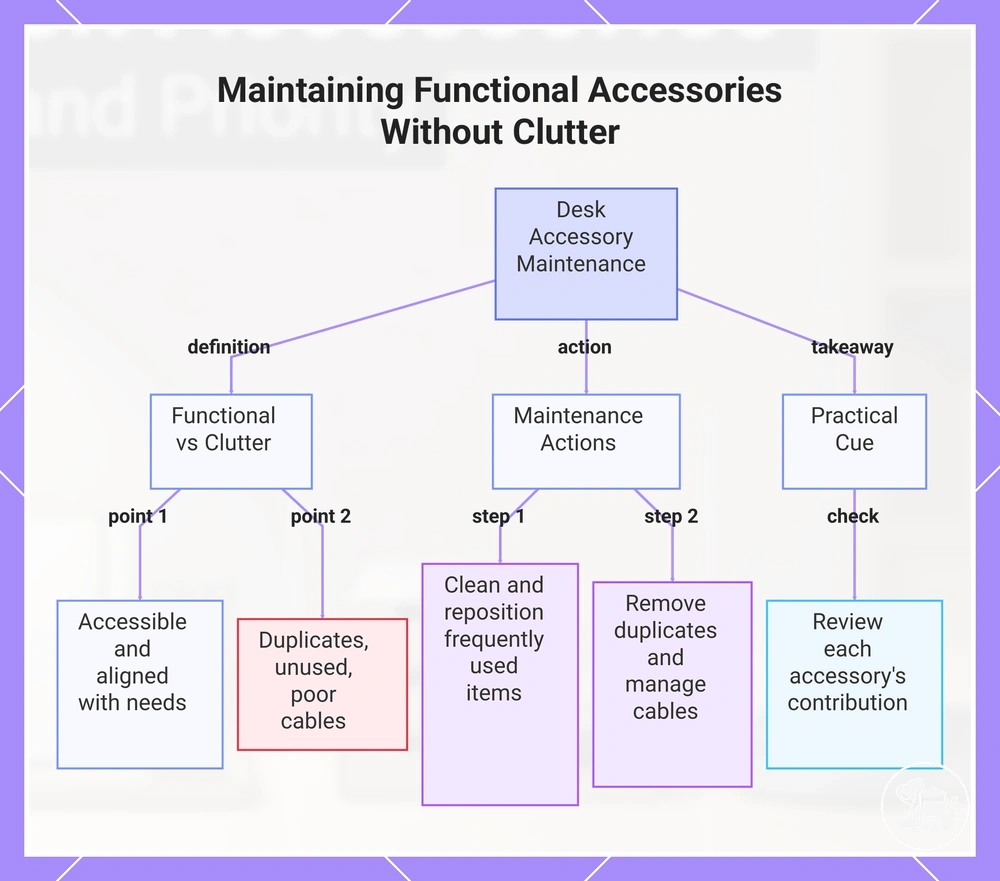
Maintaining Functional Accessories without Clutter
Maintaining accessories depends on regular review because functional accessories can become clutter when they are no longer used, misplaced, or left unchecked. A desk mat, organizer, storage item, or cable accessory may support study tasks at first but can reduce workspace efficiency if maintenance is ignored. Periodic filtering, cleaning, and organization help keep useful accessories accessible while limiting unnecessary accumulation.
Functional retention differs from clutter accumulation based on whether an accessory continues to support daily study use. Functional accessories are usually easy to access, appropriately placed, and aligned with current desk needs, while clutter often consists of duplicates, unused supplies, or poorly managed cables. Desk maintenance focuses on preserving access and usability rather than keeping every accessory in place. A practical maintenance cue is to review whether each accessory still supports organization, access, or workspace efficiency. :contentReference[oaicite:0]{index=0}
- Desk mat or organizer → Cleaning → Removes dust and surface buildup → Helps maintain usability and workspace organization
- Frequently used accessory → Repositioning → Improves access and placement → Supports efficient daily study use
- Extra supplies or duplicates → Removal or relocation → Reduces unnecessary clutter → Preserves workspace availability
- Chargers and cables → Cable re-routing → Improves desk order and accessibility → Can reduce tangling and misplaced wires
- Books, papers, and stored items → Storage review → Keeps relevant materials accessible → Supports long-term workspace organization
This chart shows how to distinguish functional accessories from clutter and apply maintenance actions to preserve workspace efficiency.